The building passed the walk-through at noon. By 6 PM the owner was back on the phone: "It smells like smoke again."
The crew had cleaned the visible soot. The soft goods were gone. The walls had been washed. Deodorizer had been applied. The job looked finished in daylight.
Then the HVAC system cycled, the sun warmed the exterior wall, the pressure in the corridor changed, and the odor came back through the building like the job had never happened.
That is the part of fire restoration that humbles good crews. Smoke odor is not a smell problem. It is a residue, pathway, and temperature problem. If the residue reservoir remains, odor control becomes a temporary disguise.
Fire residue is smaller than the visible damage
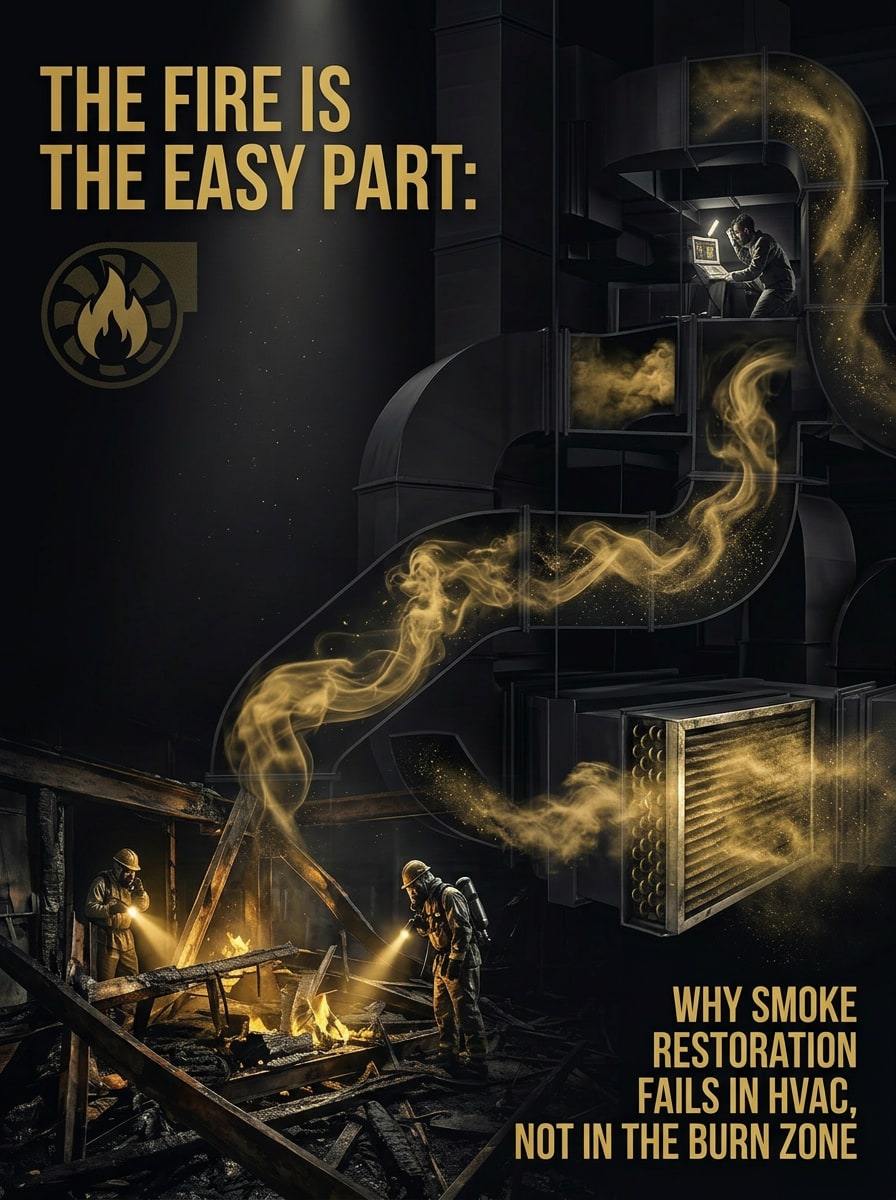
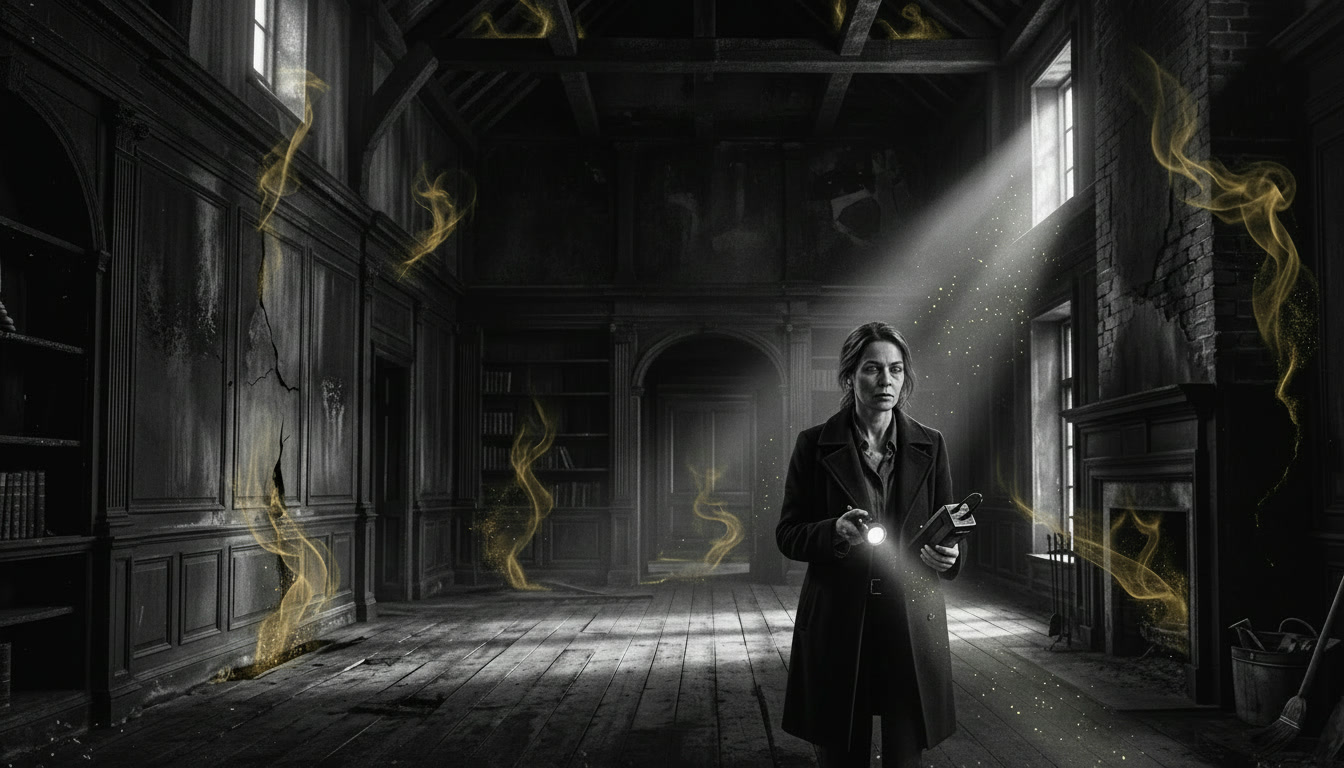
The burn zone tells only part of the story. Smoke deposits follow heat, pressure, air leakage, and HVAC movement. Residue can settle in returns, duct liners, insulation edges, wall cavities, cabinet voids, attic bypasses, and porous contents long after the visible soot line ends.
The IICRC S700 fire and smoke restoration framework centers assessment of residue impact, boundaries, building systems, contents, odor management, documentation, and work planning. That language matters. The standard treats odor as part of a system, not a finishing spray.
EPA indoor particulate guidance also matters because smoke is particulate-heavy. Fine particles can get deep into the lungs and can remain part of the indoor environment through deposition and resuspension. A visible wipe-down does not answer whether the particulate reservoirs have been removed.
The three places odor hides
Most odor return calls trace to one of three reservoirs.
| Reservoir | Why it gets missed |
|---|---|
| HVAC and duct pathways | Smoke migrates through returns and deposits downstream of the burn zone |
| Porous contents | Fabric, paper, upholstery, and unfinished wood retain odor under temperature change |
| Hidden cavities | Chases, attics, wall voids, and cabinet backs trap residue outside visible scope |
The work plan has to inspect all three. If the crew only cleans the surfaces the owner can see, the job is built to fail the first warm afternoon.
HEPA capture before chemistry
The sequence matters. Dry particulate should be captured before wet cleaning or odor chemistry drives residue deeper into porous material. HEPA vacuuming, dry sponge work where appropriate, and controlled removal of damaged material reduce the source load before deodorization starts.
That is why true HEPA equipment matters in fire restoration just as much as in mold. OSHA defines HEPA performance at 99.97% efficiency for 0.3 micrometer particles in the respiratory protection context, and DOE standards carry the same performance idea for filter specification. A "good vacuum" is not automatically a HEPA capture device.
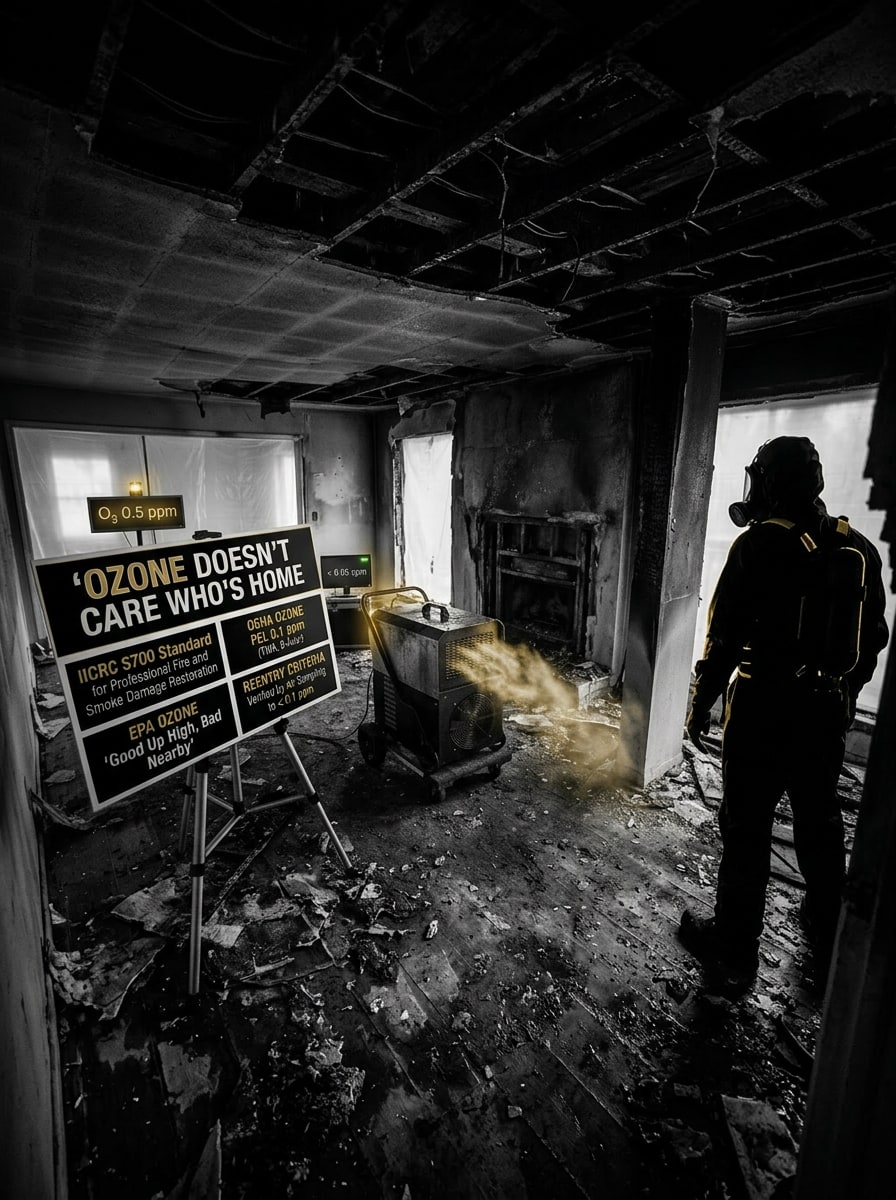
Chemistry has its place. Odor counteractants, pairing agents, thermal fogging, hydroxyl, ozone where legally and safely appropriate, and sealers can all be legitimate tools. None of them replace source removal. Used too early, they create a cleaner-smelling failure.
HVAC is not a side note
Fire odor often returns when the mechanical system restarts because the HVAC system moved smoke during the event and then re-mobilizes residue after cleaning. Returns, filters, coils, duct interiors, flex duct, insulation liner, and supply boots all need evaluation.
The decision tree is job-specific:
- Replace filters immediately and again after cleaning cycles.
- Inspect returns and supply pathways for visible deposits.
- Isolate the system during dirty work.
- Decide whether duct cleaning, component cleaning, or replacement is required.
- Confirm that pressure relationships do not pull odor from untreated spaces.
This is also where PPE returns to the conversation. Fire residues can include irritant particles, combustion byproducts, and contaminated dust. Respiratory protection should be selected based on the hazard, not on the fact that the flame is gone.
Odor control has to be documented like drying
The strongest fire jobs document odor boundaries the way water jobs document moisture boundaries. At minimum, the file should show:
- Initial residue map by room, system, contents, and hidden cavities.
- HVAC inspection findings and filter changes.
- HEPA cleaning sequence and equipment used.
- Porous contents disposition: clean, pack-out, ozone/hydroxyl treatment, or disposal.
- Chemistry applied, including dilution, dwell/contact time, and surface compatibility.
- Final odor inspection under normal building operation, including HVAC cycling.
The final point is the one most rushed jobs skip. If the walkthrough happens before the HVAC system, sun load, and building pressure return to normal, the test does not represent occupancy.
Sealers are not forgiveness
Encapsulants and smoke sealers are powerful tools when used at the right point in the sequence. They are not forgiveness for incomplete cleaning. Applying sealer over residue that should have been removed can trap odor temporarily, create adhesion problems, and leave a future contractor with a harder substrate to diagnose.
The stronger sequence is source removal, particulate capture, surface cleaning, verification of residue reduction, and then sealer where the material, odor pathway, and work plan justify it. That means the supply list needs both the cleaning stack and the finishing stack. A crew that has sealer but not enough HEPA filters, soot sponges, degreaser, PPE, or access equipment is being pushed toward the wrong step too early.
Contents can re-contaminate a clean structure
Fire odor also returns when contents come back too soon or were never treated to the same standard as the structure. Paper, fabric, upholstery, unfinished wood, and cardboard can all hold residue. If those items are stored in a cleaned structure while still odor-loaded, the building becomes the clean chamber for contaminated contents.
The decision is not sentimental; it is procedural. Contents need a disposition: clean, pack out for treatment, ozone/hydroxyl where appropriate and safe, seal, or dispose. The file should show the decision by category, not just "contents handled." Owners remember the couch that still smells. Carriers remember the second invoice.
Stampede stocks fire restoration as a sequence, not a shopping list: HEPA vacuums, filters, soot sponges, chemical lines, sealers, PPE, odor-control equipment, containment, and the replacement consumables that keep the job moving through the second and third pass. Fire and smoke restoration is not finished when the smell is covered. It is finished when the source is gone.
When the storm hits, your supply chain should not leave odor control waiting on the exact product the work plan needs. Smoke will find every untreated pathway. The job has to be stocked to find them first.
Sources

DFW-based distributor of restoration, abatement, and environmental supplies. Built to give crews a partner, not a vendor.