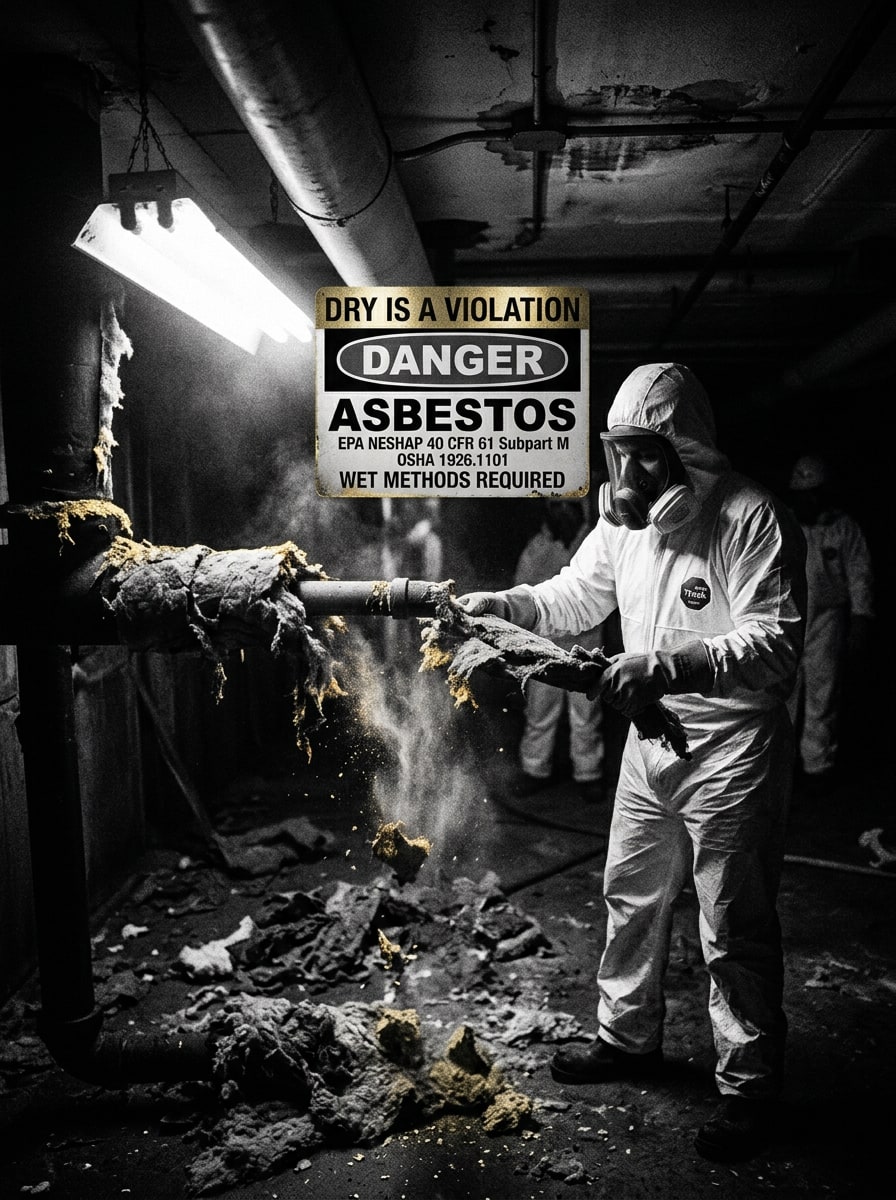
The containment looked right from the hallway. Six-mil poly tight to the door frame. Zipper entry sealed. Warning signage up. Negative-air ducted out through a window panel. The machine was running, the crew was suited, and the superintendent was already telling the property manager the area was "under negative."
Then the hygienist put a manometer tube through the barrier and the reading wandered between neutral and barely negative. Five minutes later, a tech opened the zipper door with a full debris bag and the containment went positive.
That is the moment the job stopped being a cleaning job and became a math problem.
The mistake was not that the crew forgot negative air. The mistake was that the crew counted machines instead of calculating delivered airflow. A 500 CFM label on a negative-air unit is not 500 CFM inside a dusty containment after twenty hours of demolition, a loaded pre-filter, a bent duct run, and a sloppy make-up-air path. Containment does not respond to labels. It responds to pressure.
Start with volume, not equipment count
The first number is the enclosure volume:
| Input | Example |
|---|---|
| Length | 32 ft |
| Width | 18 ft |
| Height | 10 ft |
| Volume | 5,760 cubic ft |
If the work plan targets four air changes per hour, the minimum airflow is:
5,760 cubic ft x 4 ACH / 60 minutes = 384 CFM
That is the clean math. The field math needs a reserve. Every practical condition works against rated airflow: filter loading, duct restriction, equipment age, bends, make-up-air imbalance, and door cycles. A containment that calculates at 384 CFM should not be run by one nominal 500 CFM machine with no backup. It should be run with enough capacity to hold the pressure differential after the easy airflow is gone.
EPA commercial mold guidance and IICRC S520 both push the same logic: contain the affected area, control migration, capture airborne particulate with HEPA filtration, and verify the work. The standard is not asking for a machine to be present. It is asking for the work zone to behave.
True HEPA is not a marketing phrase
The next failure hides inside filter language. Restoration crews use "HEPA" casually, but regulatory and standards language is more precise. OSHA defines a HEPA filter in the respiratory protection standard as at least 99.97% efficient at removing 0.3 micrometer monodisperse particles. The Department of Energy HEPA specification points to the same performance class.
That matters because mold disturbance is a particulate problem. If a unit is HEPA-type, HEPA-style, or simply fitted with an aftermarket filter that does not seal correctly to the cabinet, the job may be moving air without controlling the contaminant. The containment looks active while the spore load is being redistributed through the leakage path.
The pre-filter cadence decides the pressure curve
The expensive filter is not usually the first thing that breaks a containment. The cheap pre-filter is.
Pre-filters protect the HEPA media, but they also become the choke point. Drywall dust, microbial fragments, insulation fibers, and demolition debris can load a pre-filter fast enough that a morning pressure reading no longer describes the afternoon condition. If the crew is not carrying enough pre-filters, the jobsite starts rationing airflow without calling it rationing.
The operational fix is simple:
- Log pressure at startup, after active disturbance begins, after each filter change, and at closeout.
- Carry pre-filters in multiples, not singles.
- Treat a falling manometer reading as a supply event, not only a supervisor note.
- Size the stack so one unit can be serviced without the containment collapsing.
That is where distribution becomes part of the engineering control. A contractor cannot maintain a filter-change cadence with filters that are two days away.
Door cycles are part of the calculation
The other number crews forget is human movement. A containment with perfect pressure while sealed can fail every time a debris bag leaves the zone. Door cycles create momentary pressure loss, and repeated momentary failures become a migration pattern.
For higher-risk work, the math has to include:
- A defined decontamination path.
- Bag-out staging that does not force the main containment door to become the workhorse.
- Make-up air that enters from a controlled clean area.
- Enough negative-air reserve to recover quickly after entry and exit.
The manometer tells the truth here. If the reading drops to neutral every time the zipper opens and takes three minutes to recover, the containment is operating on hope.
The right question to ask before demolition
Before the first cut, ask one question: "What is our delivered CFM under loaded conditions?"
If nobody can answer, the job is not ready. You may have enough equipment. You may not. But without the volume, target ACH, filter condition, duct layout, make-up-air path, and pressure reading, nobody knows.
The audit trail should prove the containment behaved
The best remediation contractors do not wait for clearance to learn whether the containment behaved. They build a record while the work is happening.
That record is not complicated, but it has to be disciplined:
| Log item | Why it matters |
|---|---|
| Enclosure dimensions | Establishes the CFM calculation and target ACH |
| Machine model and serial | Ties performance back to actual equipment |
| Filter-change times | Explains pressure changes during active work |
| Pressure readings | Shows the containment held under job conditions |
| Door-cycle notes | Captures bag-out, crew entry, and recovery behavior |
| Exhaust path | Documents where filtered air was discharged |
This documentation protects the contractor when a containment question turns into a clearance question. If the hygienist sees elevated counts, the file can show whether the failure was a pressure event, a cleaning event, a moisture event, or a sampling anomaly that needs a better explanation. Without the log, everyone argues from memory.
The supply-side question is redundancy
Most shops buy negative-air capacity to satisfy the average job. The crews that pass clearance consistently stock enough redundancy to survive the real job: one unit down, one pre-filter loaded early, one exhaust duct rerouted because the window panel did not fit, one zipper door cycling more than expected because the debris path changed.
That reserve feels expensive until the callback hits. A second negative-air machine, extra filters, and a manometer cost less than a failed clearance, a remobilization, and a carrier asking why the containment was never logged. The same is true for ducting, zipper doors, poly, tape, and tack mats. Containment is not a machine line item. It is a system of small parts that all have to be available at the same time.
That is why Stampede stocks the containment stack as a system: negative-air machines, HEPA media, pre-filters, poly, zipper doors, tape, ducting, manometers, and the replacement consumables that keep the setup performing after day one. Mold remediation is not won by owning one machine. It is won by keeping the pressure curve stable until clearance.
When the storm hits, your supply chain should not break. The containment math does not care why the pre-filters did not arrive. It only records the pressure drop.
Sources

DFW-based distributor of restoration, abatement, and environmental supplies. Built to give crews a partner, not a vendor.