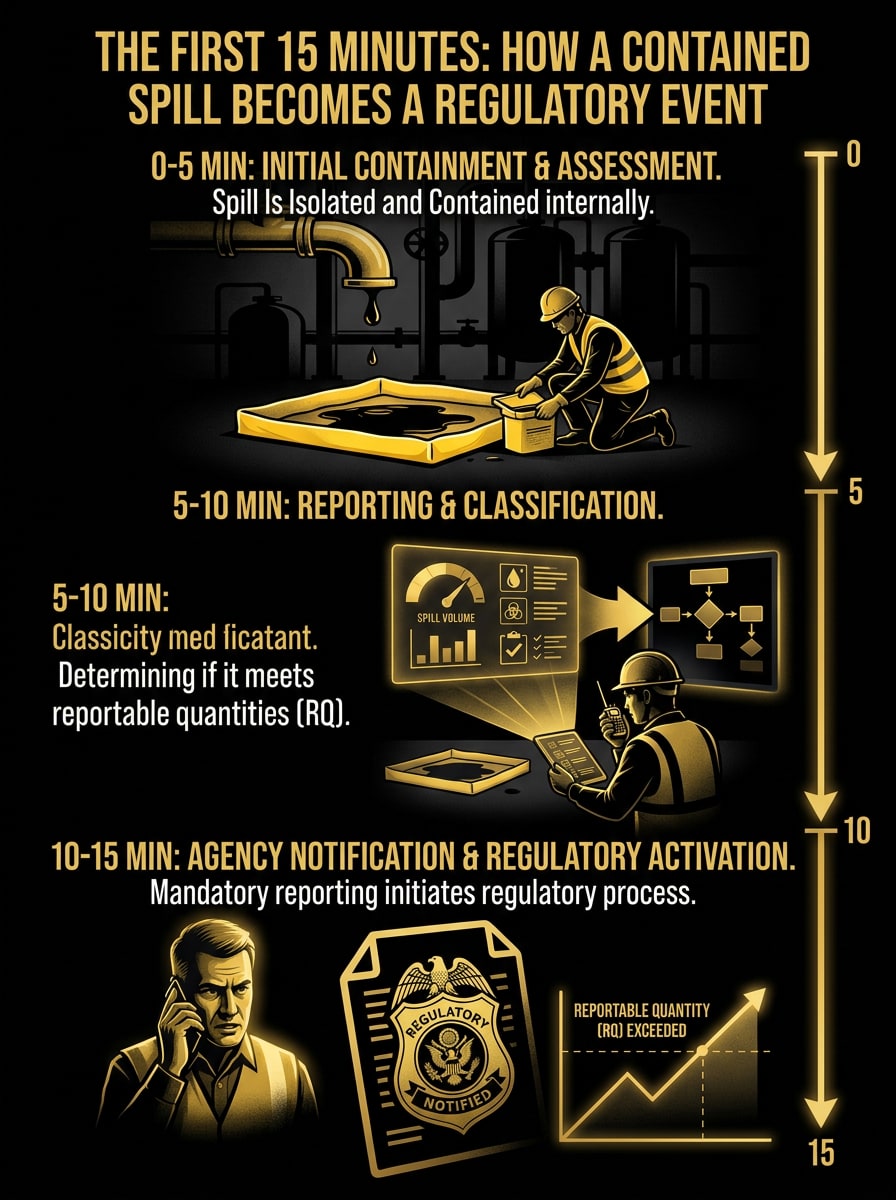
The release was still moving when the first truck arrived. Diesel across the dock approach, sheen toward the storm inlet, forklift traffic still active, and a plant manager asking whether the crew could "just throw socks around it" before the morning shift backed up.
The truck had socks. It did not have enough. It had pads. Wrong kind. It had one overpack drum, no drain cover, two suits in the wrong size, and a cartridge box that looked stocked until somebody opened it.
That is when the response stopped being a field problem and became an inventory audit conducted in public.
Emergency response crews do not get to discover truck-stock gaps at minute twelve. HAZWOPER expects planning, PPE selection, equipment readiness, communication, and response procedures before emergency work begins. EPA and DOT rules add reporting, waste, packaging, and transport consequences depending on what was released and where it went.
The first fifteen minutes are not won by heroics. They are won by what was already on the truck.
Audit against the response envelope
A truck-stock audit should not start with a generic checklist. It should start with the contractor’s actual response envelope:
- Fuels and petroleum products.
- Wastewater, sewage, and gray water.
- Acids, caustics, solvents, and unknowns.
- Biological contamination.
- Confined or limited-access areas.
- Outdoor releases near soil, drains, and waterways.
- Facilities with special reporting or shutdown requirements.
Each envelope creates different stock requirements. Oil-only pads are not universal sorbents. Universal pads are not chemical-resistant PPE. A drain cover is not the same thing as boom. A salvage drum is not automatically a DOT-ready shipping container for every waste stream.
The first-fifteen-minute kit
The most useful audit is built around the first fifteen minutes of action:
| Need | Stock that has to be present |
|---|---|
| Stop migration | Socks, booms, drain covers, diking material |
| Capture liquid | Pads, rolls, pillows, granular absorbent |
| Protect responders | Gloves, suits, boots, eye protection, respirators/cartridges |
| Isolate waste | Bags, labels, overpack/salvage drums, liners |
| Identify hazard | SDS access, pH paper, meters where appropriate, NIOSH Pocket Guide |
| Document and report | Camera, forms, contact tree, NRC/state reporting references |
The kit is not meant to finish every job. It is meant to keep the release from becoming a larger event while the full response is mobilized.
PPE stock has to match bodies, not boxes
Most truck audits count unopened boxes. That is not enough. PPE has to match the people who will wear it and the hazards they will face.
Audit PPE by size, type, compatibility, and cartridge service plan. A truck with one box of large gloves is not stocked for a two-person crew where one responder wears medium. A respirator without the right cartridge, current fit test, and service-life logic is not a compliant respiratory setup. A suit that protects against dry particulate does not automatically protect against splash.
This is where OSHA’s respiratory protection and PPE expectations connect to HAZWOPER. The equipment has to be selected for the hazard and used within the employer’s program. If the emergency response plan assumes Level C protection for a known scenario, the truck has to carry the actual Level C ensemble, not a partial approximation.
Overpack and waste are where crews get surprised
Containment is only the first half of the job. Once material is absorbed, the crew owns waste handling. That means compatible containers, labels, liners, and a plan for transport and disposal consistent with the waste characterization.
EPA’s SPCC framework, CERCLA/EPCRA reportable quantities, state spill reporting rules, and DOT hazardous materials rules can all become relevant depending on product, volume, location, and transport. The response truck does not need a law library, but it does need the supplies and contact tree that keep the incident moving correctly:
- Overpack or salvage drums in useful sizes.
- Poly drums or steel drums based on compatibility.
- Drum liners and closure tools.
- Hazard labels and waste tags.
- Documentation forms.
- Emergency contacts for NRC, state agencies, facility leadership, and disposal partner.
The wrong container can delay demobilization after the release is already controlled. That is avoidable.
Make the audit recurring
A one-time truck-stock audit creates a clean spreadsheet. A recurring audit creates readiness.
Run the audit after every response and on a fixed cadence:
- Reconcile used stock against the incident log.
- Replace expired, damaged, contaminated, or opened PPE.
- Verify cartridge dates and packaging.
- Confirm drain covers, booms, and socks are still packed where the crew expects them.
- Check overpack condition and closure hardware.
- Update the response envelope when new customer sites or hazards are added.
The point is not warehouse perfection. It is removing surprises from emergency work.
Tie the audit to actual customer sites
The strongest response contractors audit trucks against their customer base, not against a generic spill-kit catalog. A food plant, a fleet yard, a data center, a warehouse, a hospital, and a municipal facility do not present the same first-move problem.
For each recurring account, the response file should identify:
- Likely release materials and SDS locations.
- Drainage paths, shutoffs, and sensitive receptors.
- Required site contacts and after-hours access.
- PPE assumptions and known restrictions.
- Minimum containment stock for the credible release size.
- Waste partner and disposal pathway.
That account-level view changes truck stock. A contractor responding to fleet yards needs oil-only sorbents and drain protection in depth. A contractor serving industrial facilities may need more chemical compatibility planning. A contractor working healthcare or biohazard environments needs PPE, bags, disinfectants, and containment that match the exposure pathway.
The truck should be easy to inspect
Readiness is partly organization. If the crew cannot find the drain cover in thirty seconds, the truck is not stocked in a meaningful way. If overpack supplies live behind three unrelated bins, they will not be deployed during the first move. If cartridge boxes are mixed, expired, or opened, nobody should trust the count.
Use location labels, sealed bins by response type, tamper-evident restock tags, and a simple post-job reconciliation form. The goal is not a beautiful truck. The goal is a truck where the first responder can prove what is on board without digging through the whole compartment while product moves toward a drain.
Stampede stocks environmental response around the first fifteen minutes: sorbents, socks, booms, overpacks, PPE, containment, labels, and the replenishment depth that keeps response trucks ready after the last job consumed the easy inventory. Environmental spill response is a supply-chain discipline before it is a field discipline.
When the storm hits, your truck should carry the first move, not the first excuse.
Sources
- OSHA - Hazardous Waste Operations and Emergency Response 29 CFR 1910.120
- OSHA - HAZWOPER Standards Overview
- EPA - Spill Prevention, Control, and Countermeasure for Oil
- EPA - CERCLA and EPCRA Reportable Quantities
- DOT PHMSA - Hazardous Materials
- National Response Center
- NIOSH Pocket Guide to Chemical Hazards

DFW-based distributor of restoration, abatement, and environmental supplies. Built to give crews a partner, not a vendor.